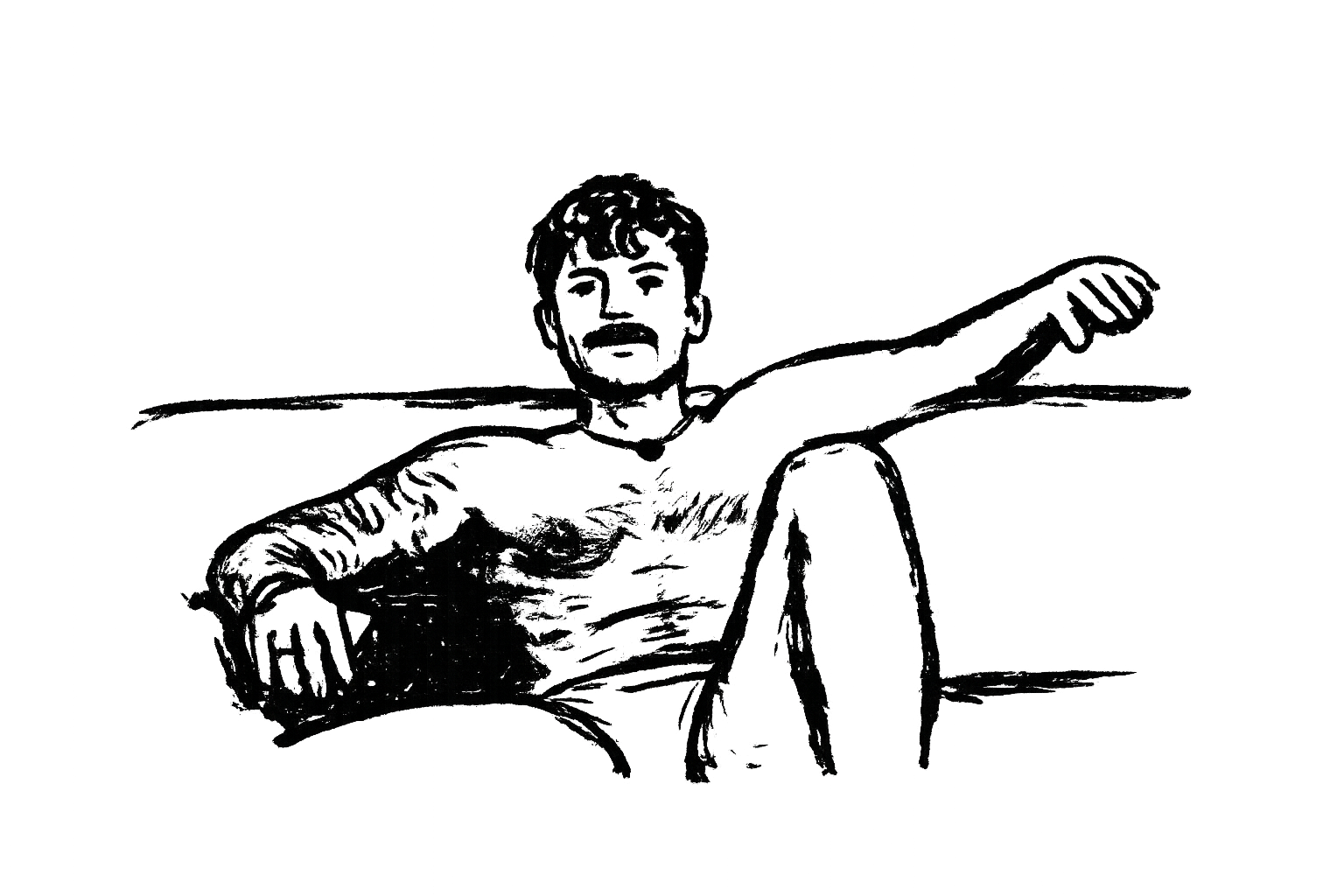

American queer culture from the 1970s through the 1990s now seems to me far more substantial than any canonization of film, however impeccable. In that semi-underground debris, in that deliberately ugly and impoverished material, queerness existed not as a dreary institution or a talking point, but as a living gesture, a systemic glitch, and a radical way of looking at the world. It is a mesmerizing moment of formation: a moment when form has not yet been cast in bronze, and utterance still retains vulnerability, risk, and a kind of living instabilitya state so magnetic that it gives rise to a strange, unappeasable desire to write about it, against all logic.
That is why Bruce LaBruce's No Skin Off My Ass, by the Canadian filmmaker, does not register for me as an artifact out of some dusty archive, but as something disturbingly alive. It lays bare, to the point of exposure, everything that constitutes the true essence of that culture: its driftlessness, its bodily insolence bordering on self-erasure, and that specific mixture of cheapness, fetish, and tenderness that cannot be simulated on a soundstage. This film does not reconstruct an era; it is the life that arose within a particular milieu rather than being neatly placed, after the fact, into a sterile context by curators and historians.
No Skin Off My Ass is one of those films that at first glance looks like pure accident: a movie cobbled together out of unsated libido, a friends-only clique, and a kind of intoxicating aesthetic rudeness. Yet with time it becomes clear that this deliberate awkwardness is not a production defect at all, but the only possible modus vivendi. The film refuses final polish and any neatly legible message. It does not want to be finished, buffed, tidily composed. It lives in the gap between the gesture and its interpretation, between desire and a parody of desire, between a love story and a mockery of the very possibility of a love story.
I have always been seduced by that border zone where the marginal fuses with physiology, and a frame aspiring to artistic dignity suddenly turns into something it becomes indecent to shield behind "the distance of intellectual interest." I have a deep distrust of vulgar psychologism, forever trying to pack every human impulse into a convenient container labeled "childhood trauma" or "forbidden fruit"— a lazy, almost petit-bourgeois way of executing meaning. But the truth is that 1 am invariably drawn to things that are defective, intermediate, aesthetically suspect. To the place where you can no longer justify your interest by invoking "high art," because the frame is too physiological, and your desire to appear an intelligent spectator finally drowns in a fully legitimate embarrassment.
That gap, perhaps, is what resonates most strongly in me. My gaze was formed by a habit of reading meaning sideways: first within the airless cultural space of the post-Soviet world, and later in France, where there is incomparably more outward freedom, yet where it becomes even clearer how quickly any radical utterance begins to be domesticated, translated into a polite language, made culturally safe. If, at "home," what hardened me was the pull of the deviant itself— the fracture, the things that categorically refuse approval-then in the Fifth Republic that pull merely crystallized. Distance helps one become more aware of one's own perversions: what draws me is not purified, "proper" queer art, but dirty transitional forms, aesthetic promiscuity, and that very indecent handmade quality that no curatorial sanitizing can fully subject to a sponsor's peace of mind. This is not a pose but a simple distrust of cultural gloss, especially now, when the language of otherness is domesticated faster than one can truly hear it, and in the process it loses its poisonous force.
At the center of LaBruce's film is a structure as absurd as it is oppressive: a hairdresser-demigod lures a skinhead into his lair, washes the street dirt off him, and locks him up nearby, trying to appropriate not so much the body as the very manner of his inaccessibility. It would be the perfect fairy tale of capturing the object of desire, were it not being told by someone with no illusions about the innocence of desire itself. In LaBruce, eroticism is always infected with social chimeras. The skinhead here is neither a subject nor even a sexual fetish in the pure sense, but an overloaded cluster of codes class, visual, politically toxic which, as it happens, only adds to their erotic charge. The film works precisely because LaBruce refuses on principle to untie this knot or hand the viewer a moral indulgence.
Yeah, I locked him in the guest bedroom. I thought that's what he wanted.
What occupies me is not a primitive cataloguing of fetishes so much as the mechanism by which sexual obsession is transformed into a full-fledged intellectual construct. In essence, any desire is not a naked physiological datum but a specific aesthetic regime: the dictatorship of the frame, the precision of the pose, an intonation behind which there hides not so much passion as yet another carefully chosen mask. No Skin Off My Ass matters precisely because nothing here is reducible to banal admiration of a silhouette or a social role. A certain elusive depth emerges from the nonconforming, provocatively "dirty" material itself. LaBruce shoots "badly" in the only register where aesthetic messiness and lopsidedness prove more honest than any ironed-out academicism. There is in him a principled refusal of gloss, a complete lack of shame before his own poverty- scenic, budgetary, and, above all, bodily.
Oddly enough, this film lacks the savagery one expects from LaBruce. What surfaces instead is a kind of softness all but extinct in radical underground work— not syrupy, God forbid, but angular, almost shamefaced. He does not ennoble his characters or slip the viewer any convenient crutch in the form of sympathy. And yet beneath this jeering, sneering surface there suddenly appears a strange line of credit extended to human absurdity. His characters may be pathetic, comic, or trapped in the cramped chambers of their own imagination, but it is precisely within that total disarray that they seem frighteningly alive. They are spared the humiliating obligation to represent something or serve as an illustrative aid. Their genuine driftlessness is a luxury that appears in cinema today far less often than any political audacity, no matter how loud.
The whole goddamn world's a fag.
To this day I cannot finally decide what seduces me in this construction: the radical gesture or its sudden intellectual underside. Without provocation, the film would never produce that specific optics that compels one to return to it not as a marginal footnote in the history of the underground, but as evidence of an authentic, unsettling humility. And yet without that buried tenderness, the provocation itself would quickly run out of breath, remaining nothing more than an empty aesthetic maneuver. LaBruce balances masterfully on that unstable hinge: he needs to shock the viewer, but it is far more important to him not to let shock become meaning's final refuge.

In essence, the film is assembled from fragments of an old cinematic canon. Here one finds the classic motif of isolation, desire projected onto a mute figure, the eternal game of departure-and-retention-a plot about how sealed-off loneliness begins to generate its own illusions. But in LaBruce this dusty material has been passed through the filter of an entirely different sensibility. Every obsessive idea suddenly acquires the contours of sentimental absurdity. He takes an honorable scheme of clinical pathology and substitutes for high tragedy something far less noble, but infinitely more alive: the story of how two catastrophically mismatched fetishes can, given sufficient stubbornness, come together into a fragile semblance of human closeness. That is probably why I am so drawn to the Western queer optic of the 1970s through the 1990s, and the reason has nothing to do with banal nostalgia for an era I never lived through, nor with the collector's thrill of checking off "required names." What interests me instead is that unstable moment when a language is only just taking shape, when a culture has not yet decided what it wants to be or in what voice it wants to speak.
What draws me is not the final assembly of identity but its makeshift montage; not the dusty canon but the noisy scene five minutes before the canon comes into being; not the archive as a graveyard of meanings but the archive as a living trace not yet disinfected. In that register, No Skin Off My Ass is not a story about the dictatorship of taste at all. It is about total capitulation before the raw matter of life: poverty, sexual challenge, the debris of accidental ties, and that specific dirty air in which alone something genuine can be born. LaBruce belongs, in principle, to that rare breed of directors whose true significance emerges not in moments of official canonization-which always amount to surrendering them to the archive but in those seconds when one notices exactly how they discredit the canon from within. What seduces in his early work is this demonstrative unwillingness to choose between "high style" and pornography's physiological excess, between rarefied cinephilia and grubby basement aesthetics, between a political manifesto and an intimate fetishistic obsession.
Today such hybridity is commonplace, but in the 1990s it read differently: not as genre acrobatics, but as a total default of hierarchies, a refusal to recognize the right of certain images to "high status" while all others were simultaneously deprived of it. In that sense, No Skin Off My Ass is not merely a queer statement but a radical revision of cultural legitimacy itself.
And it is precisely here that I recognize something deeply close to myself. For all the heaviness of my academic baggage, for all my ingrained habit of dissecting reality and arranging it into hermetic intellectual boxes, I have always been drawn to the underground. But not to the kind that gets turned into a convenient emblem for sale: to a space where the articulation of thought has not yet been severed from real risk, where style has not yet become a predictable commodity. In youth this was felt on the level of instinct; later it hardened into a position.
For me, LaBruce's film is not an object of sterile "film-theoretical interest" but the confirmation of an uncomfortable truth that today it is indecent to utter in decent society: sometimes only through conscious "bad taste," bodily excess, and demonstrative untidiness does art crawl toward that degree of truth forbidden to forms that are more well-bred and more carefully composed.
That is probably why this thing has not gone flat. It exists not as a dusty monument to an era, nor as a "valuable document" of an urban marginal scene, but as an unassimilated, under-reflected spasm. One still watches it not out of politeness toward history, but for that specific, almost physical discomfort that mixture of thick embarrassment and some utterly illicit tenderness. The film does not try to recruit you into its faith, nor does it trade in moral truths with which one might leave the theater in a state of false catharsis. What LaBruce leaves behind is not a lucid conclusion but a strange residue: a dim suspicion that the most vulnerable forms of closeness always look, from the outside, a little ridiculous, a little shameful, and catastrophically homemade. That, perhaps, is where its exceptional, almost provocative honesty lies. No Skin Off My Ass neither romanticizes the bottom nor exploits the currently fashionable optics of trauma.
It simply records a world in which desire is inseparably fused with bad taste, fetishism, playacting, and a conscious refusal to be aesthetically "correct." And yet within this universe, glued together out of random details, poses, and bodily improvisation, something faintly resembling feeling suddenly comes into view. Not grand, not redemptive, and certainly not cleansed of perverse ambiguity— but perhaps for that very reason, in its very nonconformity, it feels like the only thing that is real.